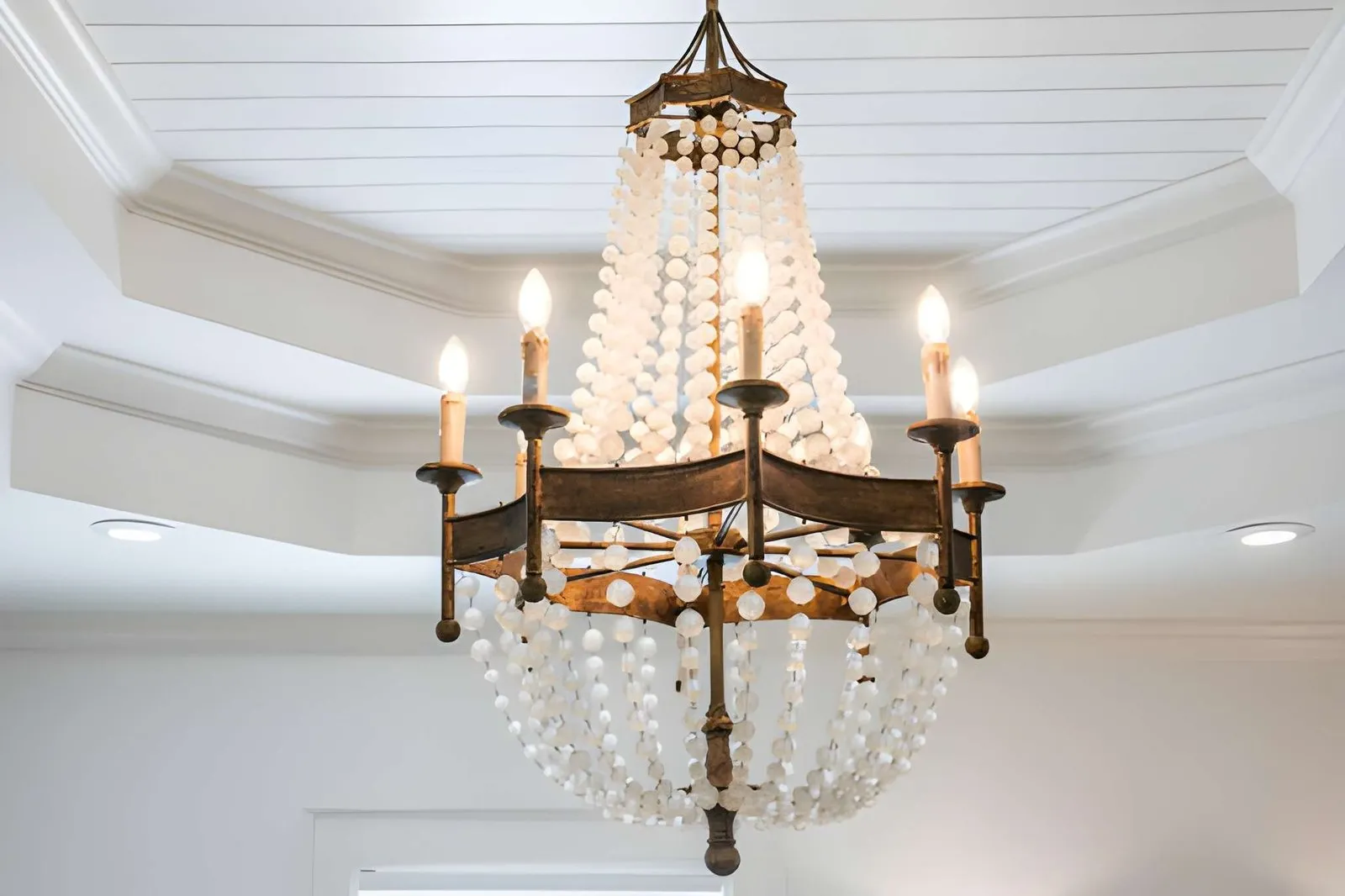
A chandelier makes a room feel finished, but it should not be asked to do all the work. The most comfortable rooms use several kinds of light, and the chandelier is usually one of them. Knowing where it fits helps you choose the right style, size, and brightness.
The chandelier as ambient light
Lighting designers describe three layers: ambient, task, and accent. A layered light explainer from CNET defines ambient lighting as the main source of light in a room and lists chandeliers among the common ways to provide it, along with floor lamps, recessed lights, and ceiling fans. It calls ambient light the base layer, the foundation on which the rest of the lighting design is built, and says it should fill the room with enough brightness that you are not stumbling in the dark.
That is a useful way to think about a chandelier. It sets the general glow. The other layers add function and character.
Adding task and accent light
Task lighting illuminates a specific area. A reading lamp by a chair, the lights around a bathroom mirror, and a pendant over a sink all count. Accent lighting highlights something you want to notice, such as a fireplace, a bookshelf, or artwork. Without these layers, a chandelier alone can leave corners dim and surfaces flat.
In a dining room, for example, the chandelier lights the table and the center of the room. A buffet lamp or a pair of wall sconces adds task light for serving. A small picture light shows off art. Together they create depth that a single fixture cannot.
Choosing a style
When you shop for the best modern chandeliers, think about the job first, then the style. Rooms with low ceilings call for compact, horizontal designs. Rooms with tall ceilings can handle vertical, branching forms. Open floor plans benefit from pieces that read well from several angles.
Common modern styles include:
- **Linear bars** that suit long tables and islands.
- **Spherical clusters** that soften angular rooms.
- **Geometric frames** that feel architectural.
- **Sculptural arms** that act almost like art.
Choose finishes that relate to the other metals in the room, such as faucets, door handles, and cabinet pulls.
Balance and dimming
Layers work best when you can adjust them. The explainer notes that dimmable ambient light can be lowered for a movie night or brightened for a party. Putting your chandelier on a dimmer is the simplest way to get that flexibility. It also lets you use a brighter bulb without making evenings feel harsh.
For accent lighting, the same source suggests choosing a bulb two to three times brighter than the surrounding light so the highlighted object stands out. That tip helps you plan the ratio between a chandelier and nearby accent fixtures.
Think about color temperature
Keep the color temperature consistent across the layers in a room. Warm white tends to feel welcoming in dining rooms and living rooms. If you mix very cool and very warm bulbs, the room can look uneven. Check the Kelvin number on each bulb package before you buy.
Plan the whole room
Before ordering, list every light source in the room. Note which layer each one fills and whether it can be dimmed. If something is missing, add it. It is usually easier to add a lamp or a sconce than to compensate for gaps with a brighter chandelier.
The takeaway
A chandelier is an excellent ambient source and a powerful design feature. Give it supporting task and accent lights, put it on a dimmer, and keep color temperature consistent. With that plan in place, the chandelier you choose will make the room feel complete and comfortable at any time of day.